Uruguay · Montevideo
Estadio Centenario
The ground of the first World Cup is due to host a centenary match on 8 June 2030. Work announced from April 2027, funding still open.
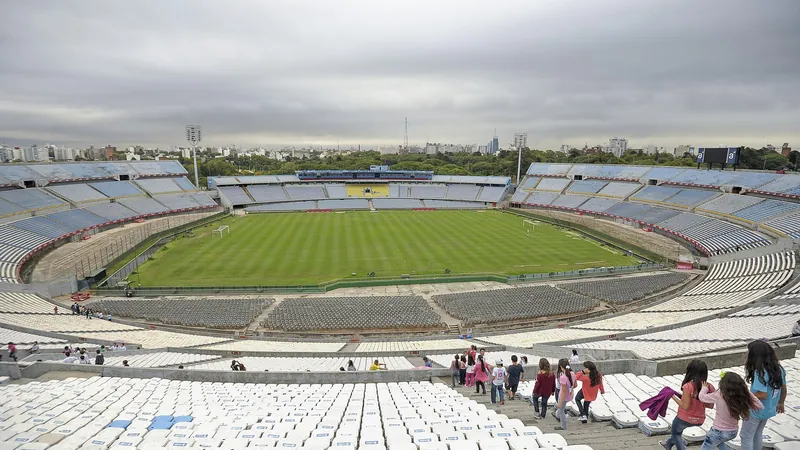 Photo : Santiago Barreiro
· CC BY-SA 2.0
Opened on 18 July 1930 for the first World Cup, the Estadio Centenario takes its name from the centenary of Uruguay’first constitution. According to the AUF (30 July 2024), it is the only ground in the world listed as a historical monument of world football, a distinction received in 1983, and it announces a capacity of 60,000. Its four stands are called Amsterdam, América, Colombes and Olímpica.
The ground belongs to the AUF, the land to the Intendencia de Montevideo, and the whole is run by the CAFO, the Comisión Administradora del Field Oficial. The Uruguayan football museum occupies 3,000 m² in the Tribuna Olímpica, on Avenida Ricaldoni, next to gate 13: open Monday to Saturday from 10am to 5pm and Sunday from 11am to 3pm, 400 Uruguayan pesos for foreign visitors, 200 for Uruguayans, 90 for pensioners, free under 12 (prices and opening hours taken from the stadium’official site on 19 October 2026).
2030
The Centenario is due to host a centenary match on 8 June 2030, a date that is still provisional. On 14 October 2026, the president of the CAFO, Gonzalo Trabal, told the daily El País that work would begin “from April 2027”, for a target capacity of 63,000. It is the first start date ever announced for this stadium.
That timetable has already slipped once, and it is worth knowing before booking a trip: in August 2024, the president of the AUF, Ignacio Alonso, announced work starting in late 2025 or early 2026 and a stadium closure of two and a half years. Nothing had begun by mid-October 2026.
Funding remains the open question. The cost was put at $120 million by the Uruguayan government in June 2026, at $120 to $140 million in the press in August 2024, and at up to $180 million according to other estimates. As of 14 October 2026, no contractor, no closure period and no delivery date had been announced. April 2027 is therefore an intention announced by the president of the commission that runs the stadium, not a contractual timetable.
Getting there
The stadium sits in the Parque Batlle, east of the centre, at the corner of Avenida Federico Vidiella and Avenida Dr. Américo Ricaldoni. The simplest landmark is the Tres Cruces terminal, where long-distance coaches arrive: 1.8 km by road, around twenty minutes on foot (distance measured on 19 October 2026 using OpenStreetMap data). Carrasco international airport is 17.3 km by road, measured the same way.
Montevideo has no metro: everything runs on buses and taxis. According to the list published by the Intendencia de Montevideo in November 2021, the lines that serve the stadium and stop on Avenida Italia are the 21, 64, 71, 115, 151, 174, 300, 370 and 407; those that stop on Avenida Ricaldoni, closest to the stands, are the 76, 143, 185, 186, 191, 192, 316, 328, 329 and 494. That list is four years old and has not been republished since: check it again on the city’official journey planner before travelling.
Around the stadium
The stadium stands in the middle of a park, and that changes how you plan a day there: there is no shopping street at the foot of the stands. The districts where hotels and restaurants are concentrated are Tres Cruces, around the terminal, 1.8 km away; Pocitos, on the seafront side; and the Centro with the Ciudad Vieja, around Plaza Independencia, 5.3 km by road (distances measured on 19 October 2026).
For a meal without hunting around, the food hall of the Mercado Agrícola de Montevideo, Avenida José L. Terra 2220, is 3.9 km from the stadium by road. We give no restaurant or hotel prices here: the dated price markers are on the Montevideo city page, and they move faster than this one.
Match day
On big match days, access changes completely. The Intendencia de Montevideo closes Avenida Ricaldoni, Avenida Morquio and Avenida Centenario to traffic, cuts off the side roads of the Avenida Italia tunnel so pedestrians can cross, and above all removes every bus stop on Avenida Centenario and Avenida Ricaldoni (Intendencia mobility plan, published 9 November 2021, updated 9 January 2025). In other words, the lines that normally drop you in front of the stands are diverted that day: aim for a stop on Avenida Italia and walk the rest, rather than counting on the nearest stop.
8 June 2030 falls in the middle of the southern winter, which many supporters travelling from Europe do not expect. June normals for Montevideo, Prado station, 1991-2020 period published by INUMET: 11.9 °C mean temperature, 15.6 °C mean maximum, 8.2 °C mean minimum, 89 mm of rain spread over 7 days on average. A waterproof jacket and something warm for the evening are more use than a shirt.
Matches at this stadium
See all →- 8 Jun 2030 Kick-off time not published
🇺🇾 Uruguay– Opponent to be confirmed
To be confirmed 2030 stadiumFIFA has confirmed that the 2030 World Cup will open here: opening ceremony and first match at the Centenario. The exact date, the kick-off time and the opponent, however, have not been published — the date shown is the announced tournament opening, for guidance only.
FIFA — le Congrès extraordinaire désigne les hôtes des éditions 2030 et 2034CONMEBOL — la Coupe du monde du centenaire 2030 débutera en Amérique du Sud
Sources
- AUF — Le nouveau Centenario presente dans le Bid Book 2030 (capacite 60 000, monument historique en 1983) (2024-07-30)
- Site officiel du stade — Musee du football uruguayen : adresse, horaires, tarifs (2026-10-19)
- Site officiel du stade — Tribunes et acces (Amsterdam, America, Colombes, Olimpica) (2026-10-19)
- Intendance de Montevideo — Lignes de bus desservant le stade, arrets avenue Italia et avenue Ricaldoni (2021-11-17)
- Intendance de Montevideo — Plan de mobilite : zone d exclusion et arrets supprimes les jours de match (2025-01-09)
- INUMET — Tables statistiques, normales 1991-2020, station du Prado (Montevideo) (2026-10-19)
- Infobae — L Uruguay fermera le Centenario deux ans et demi ; chantier annonce fin 2025 ou debut 2026 (2024-08-09)
- Infobae — Les travaux du Centenario commenceront en avril 2027 ; la CAFO devient une association civile (2026-10-14)
- Infobae — La réforme du Centenario coûtera 120 M$ ; Orsi cherche des investisseurs (2026-06-09)
- Búsqueda — La réforme du Centenario au point mort (2026-01-18)
Last checked : 19 October 2026