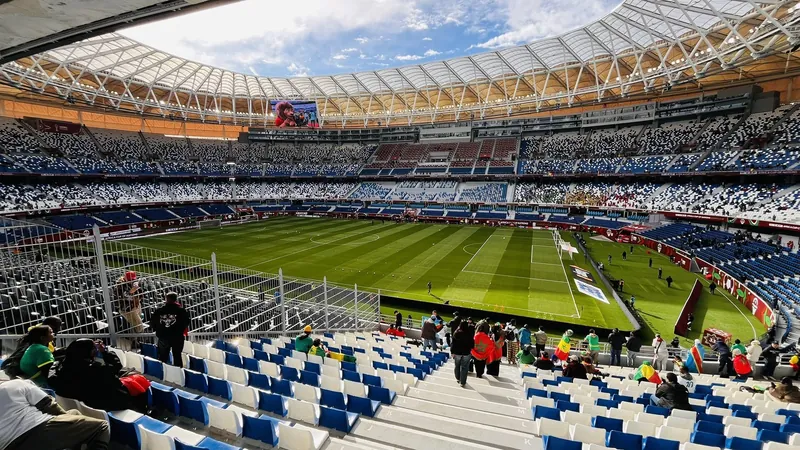
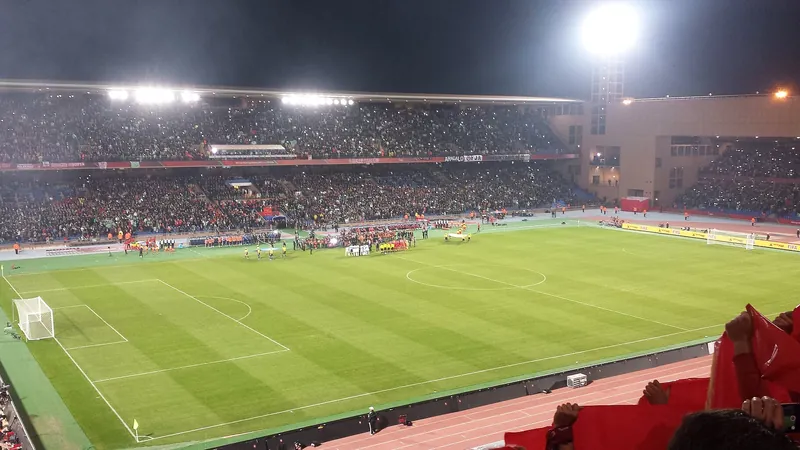
Grand Stade Hassan II
At Benslimane, some forty kilometres from Casablanca, Morocco is building what is billed as the future largest football stadium in the world: 115,000 seats under a giant “tent”. A declared candidate for the final.
Morocco · Rabat
Demolished and rebuilt from scratch, the Rabat stadium was inaugurated on 4 September 2025 and hosted the 2025 Africa Cup of Nations final. Its operator states 68,095 seats. One point matters for travellers: there is no tram nearby, access is by bus or taxi.
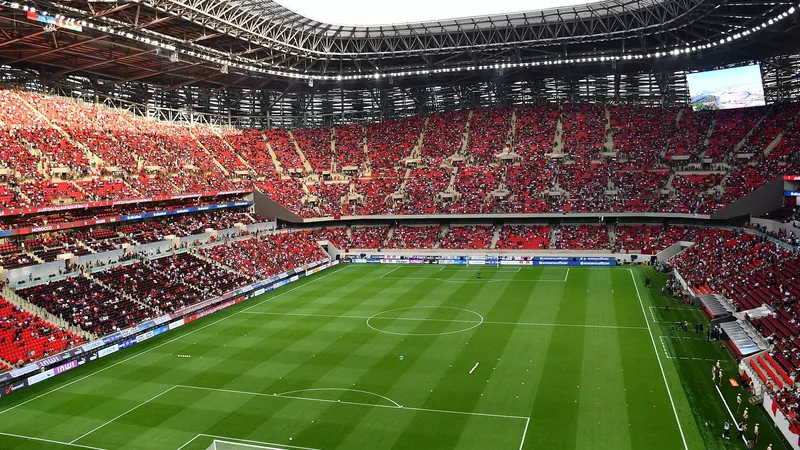 Photo : Reda benkhadra
· CC BY-SA 4.0
The Prince Moulay Abdellah stadium, opened in 1983, was entirely demolished and rebuilt on the same site, on Avenue Hassan II. Crown Prince Moulay El Hassan inaugurated the new ground on Thursday 4 September 2025 (Yabiladi, 4 September 2025). CAF, for its part, gives 5 September 2025 as the reopening date: both dates coexist in the sources and we are not settling the matter. The stadium is home to AS FAR and the Atlas Lions.
Its operator SONARGES, the state-owned company that runs Morocco’s stadiums, states 68,095 seats rising to 68,700 by 2030; CAF publishes exactly the same figures on its stadium page (pages checked on 19 October 2026). On inauguration day, Yabiladi already announced 68,700 seats. The figure of 69,500, still widely quoted, appears on none of these three sources.
The operator’s page details the fit-out: a hybrid natural pitch, presented as the first of its kind in Africa, floodlighting meeting FIFA standard A, one hundred VVIP and VIP boxes totalling 1,643 seats, two VIP lounges (1,308 seats), one VVIP lounge (225 seats), four hospitality lounges (3,861 seats), 1,803 press seats, four dressing rooms, a central kitchen and a training pitch certified FIFA category 1. Yabiladi counted one hundred and ten boxes and five hospitality lounges totalling around 5,400 seats: here too, both counts are given as they stand.
The stadium was the main venue of the 2025 Africa Cup of Nations, with seven matches according to CAF, including the final, on 18 January 2026 at 8 pm.
It is the only one of the six Moroccan venues with no heavy work left: it is finished, in service, and it has already been through a full tournament. SONARGES and CAF both announce a move from 68,095 to 68,700 seats by 2030, that is 605 extra seats, without saying what the operation would involve.
The stadium is regularly presented as the host of a 2030 semi-final. That is the ambition of the Moroccan bid, not an allocation: as of mid-October 2026, FIFA had published no distribution of matches between stadiums.
One warning sign to keep in mind when reading that official page: on 19 October 2026, the SONARGES page still described the complex as "undergoing full renovation ahead of AFCON 2025", more than a year after it reopened and nine months after the final. The page is therefore not kept continuously up to date, and its figures are worth re-reading before you travel.
One widespread idea needs correcting first: there is no tram stop at the foot of this stadium. The ground stands on Avenue Hassan II, in the Yacoub El Mansour district, in the south-west of Rabat. The nearest tram stop, Madinat Al Irfane, on lines 1 and 2, is 3.41 km as the crow flies and 6.7 km by road; the Yacoub El Mansour stop is 6.1 km by road (distances measured on 19 October 2026 from OpenStreetMap data). The stadium does not in fact appear in the list of sports venues served published by the Rabat-Salé tram operator.
Real access is by bus or taxi. Six ALSA bus routes stop within 900 metres of the stands: the 6, 31, 32H, 34, 36 and 38, several of them terminating at Bab El Had, at the entrance to the medina (OpenStreetMap survey of 19 October 2026, to be re-checked with ALSA before travelling). The tram remains useful for getting around town: 7 dirhams a single trip, with a return sold at 10 dirhams instead of 14 at full fare (operator’s website, 19 October 2026). It will not take you to the stadium.
Road distances from the stadium, measured on 19 October 2026: 2.6 km to Hay Riad, 8.3 km to Agdal, 9.0 km to Rabat-Agdal station, 11.1 km to Rabat-Ville station and to the medina, 22.5 km to Rabat-Salé airport. Note that the SONARGES page states "7 km from the city centre", while our road measurement to the medina gives 11.1 km. We quote both and do not pick a winner.
In 2029 access should change in nature. The Kénitra-Marrakech high-speed line, due to open in November 2029, plans a station at Hay Ryad, 2.6 km from the stadium by road (route and stations from Railway Gazette, 14 March 2026; distance measured on 19 October 2026). It would be by far the best way to reach the ground. Until the line opens, it has no place in a travel plan.
The stadium is not in a tourist district, and that is the first thing to take in when planning a day. Rabat’s three hubs for accommodation and dining are Hay Riad, the business and government district, 2.6 km away by road and therefore the closest; Agdal, 8.3 km away; and the historic centre, around the medina and the Kasbah of the Udayas, 11.1 km away (distances measured on 19 October 2026).
Watch out for the address, which is confusing even in official documents. The operator publishes "El Massira C.Y.M., Rabat 10000", that is Cité Yacoub El Mansour, and mapping data confirms it; yet the same page places the stadium in the "Souissi district", which is a different part of Rabat. For a taxi, it is better to ask for the Moulay Abdellah complex in Yacoub El Mansour than to give a district name.
We deliberately give no hotel or restaurant prices on this page: the dated price markers are gathered on the Rabat city page, and they change faster than a stadium page.
Coming by car is not the simplest plan. Yabiladi mentioned six car parks and five engineering structures built to ease access on inauguration day, but the two car parks described by the operator are reserved: 20,000 m² for VIPs and 9,320 m² for FIFA. We have not found a match-day traffic plan published by the city of Rabat, which does not prove none exists: to be re-checked closer to the tournament.
The World Cup is played in June and July. June normals for Rabat-Salé, 1991-2020 period, published by the World Meteorological Organization from the national meteorological service: average high 25.6 °C, average low 15.9 °C, 3.6 mm of rain over 2 days on average. In other words hot days, nights around 16 °C and almost no rain: water and a cap for a daytime match, one extra layer for an evening one.
The last point is the journey back, not the one out. CAF scheduled the 2025 Africa Cup of Nations final at 8 pm, so an evening match in 2030 will end around 10 pm: the bus routes mentioned above offer no guarantee of a late-evening service, and there are 11 km between the stadium and the historic centre. The return trip is decided before you leave, not on the way out of the stadium.
Last checked : 19 October 2026
At Benslimane, some forty kilometres from Casablanca, Morocco is building what is billed as the future largest football stadium in the world: 115,000 seats under a giant “tent”. A declared candidate for the final.
Reopened on 14 November 2025 after two years of work, the Ibn Batouta stadium holds 75,600 — the largest in Morocco until Benslimane opens.
Phase 2 under way: a full roof, upgraded stands and a rise from 40,500 to 45,860 seats, for MAD 883 million, targeting 2028.